

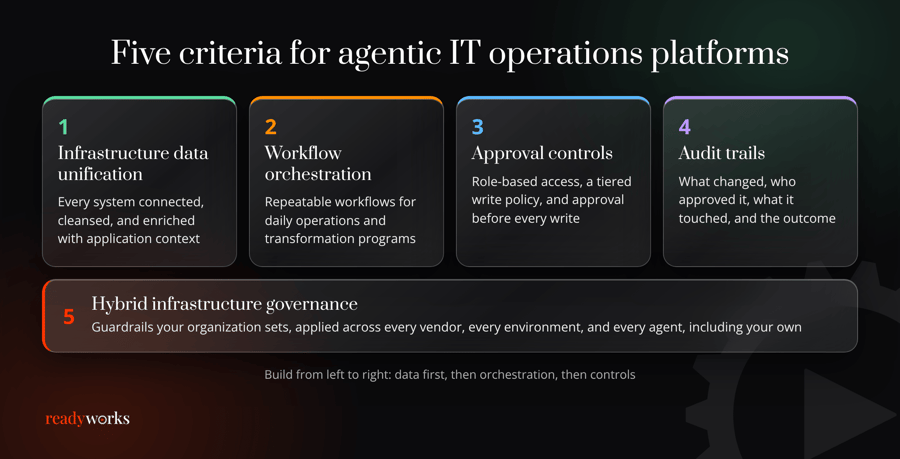
Choosing an agentic IT operations platform comes down to five things: how it unifies infrastructure data across a multi-vendor estate, how it orchestrates workflows, what approval controls sit in front of every change, what its audit trail records, and whether governance holds across your whole hybrid infrastructure. The order matters, because agents are only as safe as the data and controls underneath them. Platforms that started with the data are the ones ready for agents now. ReadyWorks has spent five years building that foundation, starting long before agents were part of the conversation.
What is an agentic IT operations platform?
Agentic ITOps puts AI agents to work running IT infrastructure, on-premises and in the cloud. The agents plan and execute day-to-day operations and transformation programs on a unified, continuously cleansed data foundation enriched with application context, within guardrails the organization sets. That is a step past AIOps, which correlates events, reduces alert noise, and points to likely root cause; an agentic platform carries out the work, with approvals and an audit trail around every action. Gartner expects 70 percent of enterprises to use agentic AI to operate IT infrastructure by 2029, up from less than 5 percent in 2025. McKinsey's 2026 State of AI survey shows the shift is already underway, with 40 percent of large organizations scaling AI agents and IT among the functions where agents scale most often.
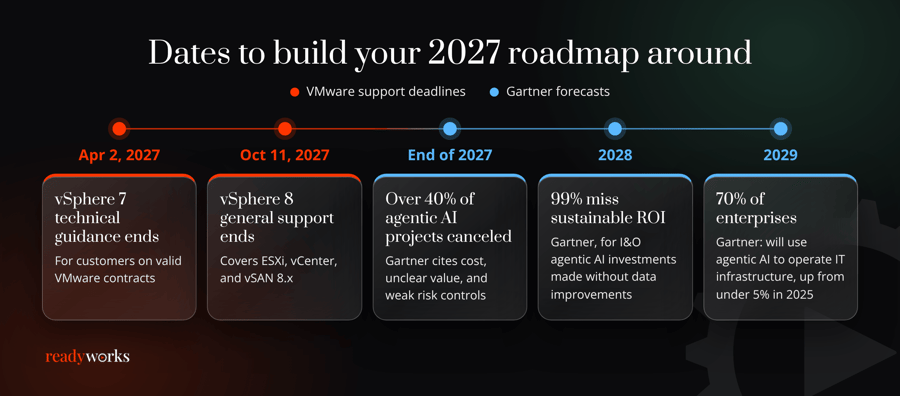
Adoption alone doesn't guarantee results. Gartner predicts that over 40 percent of agentic AI projects will be canceled by the end of 2027, citing escalating costs, unclear business value, and inadequate risk controls. It also projects that 99 percent of I&O-led agentic AI investments made without improvements to data and the operating model will fail to reach sustainable ROI by 2028. The teams that avoid both outcomes get their data and controls right before they widen what agents can do.
How did agentic IT operations grow out of the platforms that came before it?
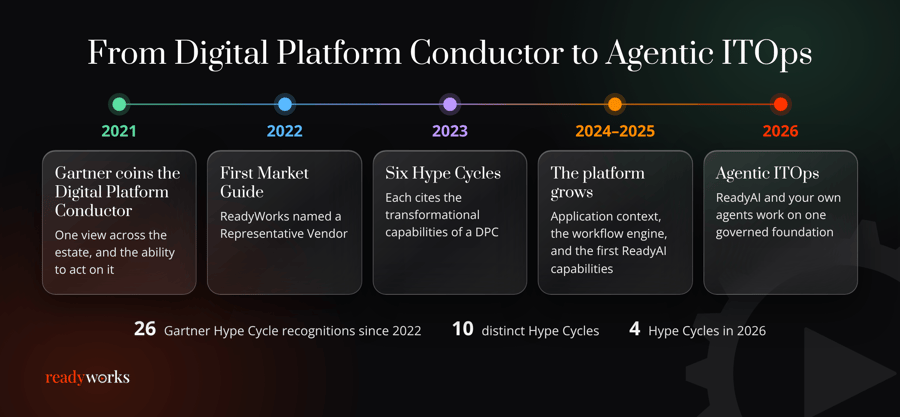
ReadyWorks started with the idea agentic platforms depend on now: one clean, connected view across the whole estate, and the ability to act on it. Gartner gave that kind of tool a name in 2021, the Digital Platform Conductor, and named ReadyWorks a Representative Vendor in its first Market Guide for the category. From there, the work was about what the platform could do with that view. Over the next few years it added the application context layer, so it could tell what a change would touch, and the workflow engine, so it could run whole programs around that knowledge. The first ReadyAI capabilities followed, and our evolution page covers the full timeline.
We wrote about each step as it happened. In January, Michal Jaworek argued that agentic AI readiness is an operations problem before it is a model problem, the same lesson the platform was built on. In October, his comparison of autonomous IT operations platforms tested each vendor on how it connects infrastructure data to business context. Through all of it, the foundation stayed the same: integrations, continuously cleansed data, and application context on every asset. What changed is what runs on it. ReadyAI now analyzes, recommends, plans, and carries out governed platform actions once a person approves them, and your own agents can work from the same foundation over MCP.
Gartner and Hype Cycle are registered trademarks of Gartner, Inc. and/or its affiliates and are used herein with permission. Gartner does not endorse any vendor, product, or service depicted in its research publications.
How should you evaluate an agentic IT operations platform?
Use the same five criteria for every platform on your list, and work through them in order. A platform that is strong at the top of the stack and weak at the bottom will act quickly on data nobody trusts.
- Infrastructure data unification. Every decision an agent makes starts with an asset record, so start there. The platform should connect the systems you already run, such as vCenter, Nutanix, your CMDB, and other systems of record, then normalize the data and keep cleansing it as the estate changes. Look for application context on every asset (dependencies, usage, compatibility, and lifecycle stage), because that is what tells an agent what else a change will touch. Ask each vendor what happens when your CMDB and vCenter disagree about the same server, and how quickly the platform notices.
- Workflow orchestration. Agents should run known, tested workflows instead of inventing a process on the fly. That means sequencing, health checks, approvals, and validation built into repeatable workflows that span your tools. The bigger test is scope. Many tools stop at incident runbooks, but infrastructure teams also run multi-month transformation programs such as a VMware exit, an endpoint refresh, or a hardware decommission. Ask whether the platform runs day-to-day operations and transformation programs on the same platform, so the data you clean for one program keeps working in the next.
- Approval controls. These decide what an agent may do without asking. Look for role-based access on every call, a tiered write policy the organization sets, and human approval before every write. Gartner projects that human involvement in IT operations workflows will fall from 95 percent to 40 percent between 2025 and 2028, so the controls need to widen gradually as results hold up, without a rebuild. Ask who can change the write policy, how it widens over time, and whether approval happens before the write or after it.
- Audit trails. A good audit trail lets you answer an auditor from a single record: what changed, who approved it, what it touched, and the outcome. Every action should be logged and explainable, and the record itself should be tamper-evident. On ReadyWorks, that means a hash-chained audit. Regulated firms feel this first, because evidence spread across tickets, email, and discovery tools gets rebuilt by hand for every audit. Ask to see the record for one change from start to finish. Our post on governed AI agents for IT operations goes deeper on this criterion.
- Hybrid infrastructure governance. Governance has to hold across the whole estate, on-premises and in the cloud, across every vendor and every agent that touches it. That includes agents you build yourself. In McKinsey's 2026 State of AI survey, 32 percent of respondents said their organizations decided against buying software because they could build it with agentic coding tools, and those agents need the same guardrails as any vendor's. Look for guardrails the organization sets once and the platform enforces everywhere, including access, write policy, approvals, optional pseudonymization, prompt-injection defense, and audit. Ask whether your own agents connect through a governed tool surface such as MCP, and whether you can bring your own model.
Most estates haven't reached the first stage on the path to autonomy yet, which is why the order matters. The path runs through five stages: Foundation, Assisted, Supervised, Conditional, and Autonomous by default. Foundation comes first, and from there AI recommends, a person approves, and trust widens one program at a time as results hold up.
Which dates should shape your 2027 plans?
Two VMware deadlines land next year. Technical guidance for vSphere 7 ends on April 2, 2027, for customers on valid VMware contracts, and general support for vSphere 8 ends on October 11, 2027. Gartner's cancellation and ROI forecasts add a second clock. The two are connected; a VMware exit forces the same data cleanup that agents need, which makes it a common starting point. Our update on the VMware migration platforms worth evaluating before the 2027 deadlines covers that path in detail.
.
Sources: Broadcom and VMware support notices; Gartner. Gartner is a registered trademark of Gartner, Inc. and/or its affiliates and is used herein with permission. Gartner does not endorse any vendor, product, or service depicted in its research publications.
What results have ReadyWorks customers seen?
Global partners and Fortune 100 customers use ReadyWorks to take months and millions out of infrastructure work. A leading European bank brought its asset data into one clean record. It ran its asset lifecycle program on the platform and lowered its asset lifecycle costs. A global financial services firm moved alerts from a multi-vendor storage and backup environment onto one platform. Its daily alert volume dropped to the items that need action, and its manual daily checks ended. A global manufacturer automated device deployment at enterprise scale. Programs like these are delivered with the partners you trust, from Nutanix on virtualization moves to Lenovo on device lifecycle programs.
Why talk to ReadyWorks before you choose an agentic IT operations platform?
Talk to us before you commit. We've been building the clean, connected data foundation agents need since the Digital Platform Conductor days, and it runs in enterprise estates today. Day-to-day operations and transformation programs run on that same foundation, so the data you clean for a VMware exit keeps working in daily operations. ReadyAI and your own agents work from it too. Every write waits for human approval, and every action is logged in a hash-chained audit you can follow from start to finish. The team behind it includes founders who have run enterprise infrastructure programs for over 30 years and executives who have delivered them for Fortune 100 customers.
Waiting has a cost. Gartner's 99 percent figure is the warning. Every quarter on fragmented data is another quarter of AI spend without a return, and the 2027 deadlines won't move. On ReadyWorks, each step pays for itself before the next begins. The data foundation delivers value with AI off. You can start with one program.
Talk to someone who has done this. An intro call takes 15 to 30 minutes. Want a plan first? Map your ten steps to autonomous IT operations in eight questions, then bring the PDF to the call.
Frequently asked questions
Can our own AI agents use an agentic IT operations platform?
On ReadyWorks, yes. Your own agents connect through a governed MCP tool surface and work from the same data, write policy, approvals, and audit as ReadyAI. You also bring your own model: Anthropic by default, Azure OpenAI, AWS Bedrock, OpenAI, Google Vertex, or a customer-hosted model.
Do agentic IT operations platforms replace ServiceNow or a CMDB?
In most cases, no. Your CMDB, ITSM, and monitoring tools stay as your systems of record. ReadyWorks connects to them, cleans and normalizes the data, and adds application context, while single-purpose tools such as readiness spreadsheets, survey tools, and custom reporting scripts are what usually retire.
How is ReadyAI priced?
ReadyAI has no charge per call or per action. Platform pricing is set in annual tiers by estate size, and migration licenses are priced per VM migrated.
Gartner does not endorse any vendor, product or service depicted in its research publications, and does not advise technology users to select only those vendors with the highest ratings or other designation. Gartner research publications consist of the opinions of Gartner's research organization and should not be construed as statements of fact. Gartner disclaims all warranties, expressed or implied, with respect to this research, including any warranties of merchantability or fitness for a particular purpose. GARTNER and HYPE CYCLE are registered trademarks and service marks of Gartner, Inc. and/or its affiliates in the U.S. and internationally and are used herein with permission. All rights reserved.