


The best autonomous IT operations platform for hybrid infrastructure is the one whose agents work from data you can trust, with enough business context to make the right call. ServiceNow, Dynatrace, IBM Concert, Splunk ITSI, and BigPanda each bring business context into operations in their own way: a CMDB, business events, financial and risk signals, service KPIs, or incident history. ReadyWorks does a different job. It connects the systems of record across a multi-vendor estate, keeps that data clean, and adds application context, so ReadyAI and the agents you build or buy work from the same accurate record. Pick the platform that matches where your trusted data lives today and the work you want agents to take on.
I lead product engineering and systems architecture at ReadyWorks, so I spend most of my time on the layer underneath the agents. Here's what I've found. The model is rarely what breaks first. The data is. An agent that reads a stale CMDB record or a server with no owner will make a confident decision on bad information, and it will do it faster than any person could.
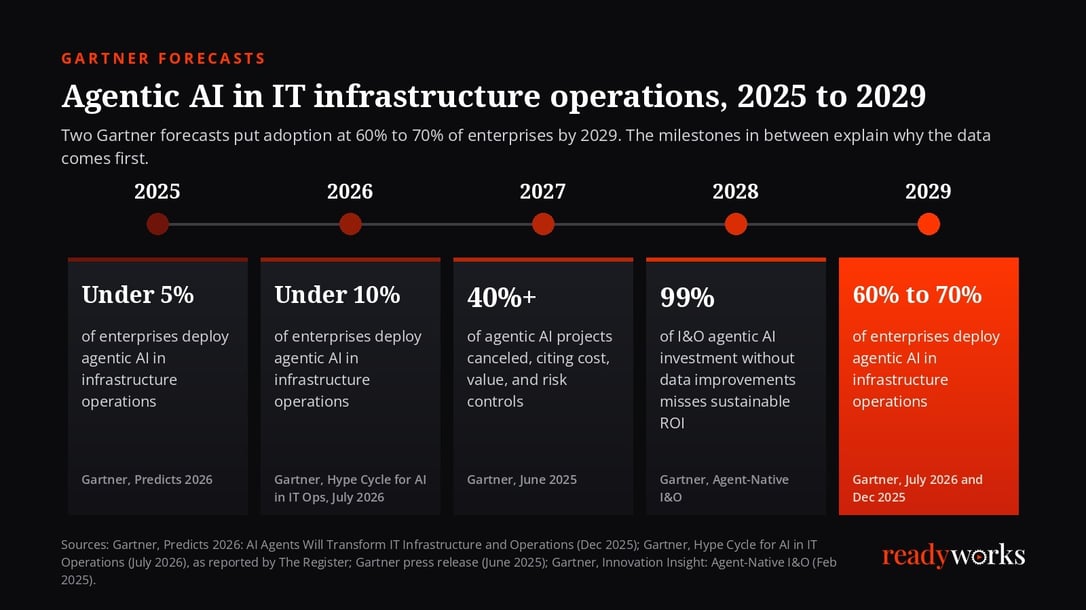
The market is moving anyway. Gartner's two most recent forecasts put agentic AI in the infrastructure operations of 60% to 70% of enterprises by 2029. Its Predicts 2026 report set the figure at 70%, up from less than 5% in 2025. Its July 2026 Hype Cycle for AI in IT Operations, as reported by The Register, puts it at 60%, up from fewer than 10% today. Either way, most enterprises will run agents on their infrastructure within three years.
The same research shows how many will stumble. Gartner predicts that more than 40% of agentic AI projects will be canceled by the end of 2027, citing escalating costs, unclear business value, and inadequate risk controls. And in its Innovation Insight on Agent-Native I&O, Gartner projects that by 2028, 99% of I&O-led agentic AI investment made without improvements to system data and the operating model will fail to reach sustainable ROI.
So this comparison looks at six platforms through one lens. How does each one connect infrastructure data to business, financial, and risk context? And what has to be true about your data before you let agents act on it?
How did we compare these autonomous IT operations platforms?
We used the same five questions for every platform. The answers come from each vendor's public product pages, announcements, and independent analyst coverage available as of October 2026.
- Data foundation: Where does the platform get asset and configuration data, and how does it keep that data accurate as the estate changes?
- Infrastructure and business context: How does it connect infrastructure to applications, services, owners, and business processes?
- Financial and risk context: Does it bring cost, vulnerability, compliance, or business impact signals into decisions natively, through a companion product, or not at all?
- Scope of autonomous work: Does it focus on incidents, or can it take on day-to-day operations and transformation programs like migrations, refreshes, and decommissioning?
- Governance: How are approvals, write permissions, and the audit trail handled? And does the vendor earn revenue from the systems its agents make decisions about? We go deeper on this in Best Governed AI Agents for IT Operations.
What are the top agentic IT operations platforms for hybrid infrastructure?
The top agentic IT operations platforms for hybrid infrastructure in 2026 are ReadyWorks, ServiceNow, Dynatrace, IBM Concert, Splunk IT Service Intelligence, and BigPanda. ServiceNow leads where the CMDB is the system of record. Dynatrace leads where telemetry is deep. IBM Concert fits IBM-heavy estates that want risk and cost signals in one view. Splunk ITSI fits teams that run on service KPIs. BigPanda focuses on incidents. ReadyWorks is the neutral data and application context foundation across all of them, for both daily operations and transformation programs.
|
Platform |
Best for |
How it adds business context |
Financial and risk context |
Scope of autonomous work |
|
ReadyWorks |
Multi-vendor estates that need one clean, neutral data foundation |
Unified data fabric across existing systems of record, plus application context on every asset |
Not calculated natively. Customer programs run on the platform have lowered lifecycle and operating costs |
Day-to-day operations and transformation programs, within guardrails the organization sets |
|
ServiceNow |
Enterprises standardized on the Now Platform |
CMDB, service mapping, Context Engine, Workflow Data Fabric |
Risk, asset, and portfolio applications on the same platform |
AI specialists across IT, security, and other functions, governed by AI Control Tower |
|
Dynatrace |
Application-heavy estates with deep telemetry |
Grail unifies telemetry with business events |
Business events support revenue impact analysis; cost and performance forecasting for AI workloads |
Observability-led operations, closed loop with ServiceNow |
|
IBM Concert |
IBM-heavy hybrid estates and regulated industries |
Shared context from Instana, Turbonomic, SevOne, and Cloud Pak for AIOps |
Vulnerability, certificate, and compliance signals; cost through Turbonomic and Apptio |
Incident response, resilience, and performance and cost actions |
|
Splunk ITSI |
Log-heavy teams that manage by service KPIs |
Service health, KPIs, and dependencies mapped to business services |
Business impact and operational risk views |
Event correlation, triage, and playbooks |
|
BigPanda |
Incident-heavy operations teams |
IT knowledge graph built from operational data, including unstructured sources |
Centers on incident and change context |
Incident detection, diagnosis, and resolution |
1. ReadyWorks
ReadyWorks is Agentic ITOps for the multi-vendor IT estate. We built it in a fixed order: data first, context second, autonomy third. The platform connects the systems you already run, such as vCenter, Nutanix, your CMDB, and other systems of record. It accesses that data on demand and in place, normalizes it, and keeps cleansing it. Then it attaches application context to every asset: dependencies, usage, compatibility, and lifecycle stage. That is what tells an agent what else a change will touch.
ReadyAI is the control plane on top. ReadyWorks analyzes, makes recommendations, and carries out the work within the guardrails set by each organization. Today ReadyAI works at the Assisted stage: it recommends, a person approves, and it carries out governed platform actions. Guardrails include role-based access on every call, a tiered write policy set by the organization, human approval before every write, optional pseudonymization, prompt-injection defense, and a hash-chained audit trail. You can bring your own model, and you can give your own agents the same foundation through a governed MCP tool surface.
Scope is where ReadyWorks differs most from incident-focused tools. Day-to-day operations and transformation programs run on one platform. VirtualReady handles virtualization exits, EndpointReady handles endpoint refreshes, StorageReady handles storage and backup alerts, and ServerReady covers server lifecycle through disposal. ReadyWorks is also neutral. It earns nothing from where workloads run or what gets bought or retired, and your systems of record, ServiceNow included, stay in place.
What to check: ReadyWorks does not calculate cost or risk scores. If you need financial or risk analytics, pair it with the tools that produce them. ReadyWorks gives those tools, and your agents, a record they can trust. We cover how this plays out in practice in the financial and risk section below.
2. ServiceNow
ServiceNow is the default choice for enterprises that already run IT on the Now Platform. At Knowledge 2026 it expanded its AI Control Tower and Autonomous Workforce and debuted Autonomous Security & Risk. Its AI specialists share the same operational intelligence through the CMDB and Context Engine, the same data connectivity through Workflow Data Fabric, and the same governance layer. ServiceNow said the Control Tower enhancements would reach general availability in August 2026.
For risk context, ServiceNow's Armis integration feeds continuous asset discovery into the CMDB, so the CMDB becomes a live, risk-aware view of the attack surface. Asset, risk, and portfolio work sits on the same platform through ITAM, IRM, and SPM.
What to check: the CMDB. Independent coverage of Knowledge 2026 noted that the architecture briefings assumed the CMDB was already structured, owned, and current. If yours is, ServiceNow is a strong fit. If it isn't, fix the data before the agents arrive.
3. Dynatrace
Dynatrace positions observability as the control plane for autonomous operations. At Perform 2026, it emphasized unifying logs, metrics, traces, user experience, and business signals in its Grail data platform, along with deeper integration with ServiceNow. Dynatrace describes business observability as including business events as a data type in Grail, which supports insights such as revenue impact and business process analysis.
On the cost side, Dynatrace added AI-driven cost and performance forecasting for AI workloads, so teams can spot risk early in AI operations.
What to check: Dynatrace context is strongest where Dynatrace telemetry is deepest. Look at how much of your estate is instrumented, and where asset facts like ownership and lifecycle stage will come from.
4. IBM Concert
IBM introduced the Concert platform at Think 2026 as an agentic operations platform. It connects signals from existing tools into shared context and coordinated action across the hybrid estate, building on Concert, Instana, Turbonomic, SevOne, and Cloud Pak for AIOps. Independent analysts reported it was announced in public preview.
Concert has the most explicit risk story in this list. IBM says it adds real-time risk signals such as vulnerabilities, certificates, compliance, and change impact to observability data, and prioritizes risk by business impact. For financial context, IBM has a native integration between Turbonomic and Apptio that puts a financial value on the actions Turbonomic recommends, so operations teams can act on the ones with the most benefit first.
What to check: Concert delivers the most value when you already run several of the IBM tools it consolidates. Map which modules you need and how they are packaged before you compare it with other options.
5. Splunk IT Service Intelligence
Splunk ITSI, now part of Cisco, approaches business context through services. It connects service health, KPIs, and dependencies to the business services they support. Practitioners use it to reduce noise and find likely root cause. Leaders use it to see service health, operational risk, and business impact in real time.
What to check: ITSI is only as good as its service model. Someone has to define the services, the KPIs, and what depends on what, and keep those definitions current as the estate changes.
6. BigPanda
BigPanda uses the term agentic ITOps for incident operations. Its IT knowledge graph turns fragmented operational data into context for detecting, diagnosing, and resolving incidents. BigPanda says agentic ITOps doesn't require highly structured data and can draw on chat histories, tickets, and change data.
What to check: scope. Most agentic ITOps tools resolve incidents. Migrations, refreshes, and platform exits sit outside that scope, so plan for them separately.
What autonomous IT operations software unifies infrastructure and business context data?
Autonomous IT operations software that unifies infrastructure and business context data includes ServiceNow, through its CMDB and service mapping; Dynatrace, through business events in Grail; Splunk ITSI, through service KPIs; and IBM Concert, through shared context across IBM's operations tools. Each one unifies context inside its own data model. ReadyWorks unifies across vendors, accessing each system of record in place and adding application context to every asset.
Here's why the difference matters. Every platform in this list is only as good as the asset record underneath it. Say an agent is asked to retire a server. Before it acts, it needs to know who owns the server, what depends on it, whether it is still in use, and whether the CMDB agrees with vCenter about any of it. If those systems disagree, the business context on top is built on a guess.
That's the order we follow. Data first: connect the systems, normalize the records, and keep cleaning them. Context second: attach the dependencies, usage, compatibility, and lifecycle stage that tell you what a change will touch. Our guide to automating VMware migration waves shows what this looks like during a migration. Autonomy third: only then let agents plan and act, inside the guardrails your organization sets.
What autonomous IT operations platforms add financial and risk context to infrastructure data?
Autonomous IT operations platforms that add financial and risk context to infrastructure data include IBM Concert, with vulnerability, certificate, and compliance signals plus cost through Turbonomic and Apptio; ServiceNow, with risk, asset, and portfolio applications fed by its CMDB; Dynatrace, with business events and cost forecasting for AI workloads; and Splunk ITSI, with business impact and operational risk views. ReadyWorks does not produce financial or risk scores. It provides the clean asset and application record those scores depend on.
And that's the part buyers tend to skip. A risk score is built from asset records. A cost model is built from asset records. If a record has the wrong owner, a retired server, or a missing dependency, the number on the dashboard will be wrong and still look precise. Gartner's 99% projection above makes the same point at the investment level.
While ReadyWorks doesn't calculate cost or risk, financial relief has been a consistent outcome of IT programs run on the platform. A leading European bank connected its existing data sources, cleaned the records, and automated its Windows update and asset lifecycle program. The result was lower asset lifecycle costs, thousands of staff hours returned each year, and audit-ready reporting for every program. After a major acquisition, First Citizens Bank built a complete inventory across both organizations and found assets it didn't know it had. That record cut data discovery overhead, lowered operating costs through application rationalization, and reduced migration and compliance risk. In both cases, the savings came from the same place: a clean, connected record that made the right decisions clear.
So when you evaluate financial and risk context, ask two questions. Where does the platform get the asset data behind the number? And who keeps that data current when the estate changes every week? In most cases, the fastest way to better financial and risk context is fixing the record those scores are built on.
Where do most estates start on the path to autonomous infrastructure management?
Most estates start before the first stage. That isn't a criticism. It's what we see when we connect real systems of record. Autonomy is a path that runs through five stages, and you move along it through use, one program at a time. Here's how it breaks down on our ten steps page.
- Foundation. Identify every system, connect them to an orchestration platform, clean the data, add application context, and set the guardrails. This is the first destination.
- Assisted. Build the workflows, test them, then run the first program. AI recommends, and a person approves every action.
- Supervised. Build confidence and widen the policy as results hold up.
- Conditional. Semi-autonomous operations, within limits the organization defines.
- Autonomous by default. The destination, reached by widening trust over time.
You set the pace. Every stage runs on the same platform, and your team can keep as much of the work in its own hands as it wants. One common starting point is a transformation program like a VMware exit, because it forces the data cleanup that daily operations need anyway. Our Enterprise VMware Migration Automation Guide covers that starting point.
What should each leader look for in an agentic IT operations platform?
- CIO: proof that AI investment will pay back. Ask each vendor what data improvements their platform needs before agents act, and how you will measure value at each stage.
- SVP or VP of IT Infrastructure: fewer tools and less noise across a hybrid estate. Ask whether the platform covers daily operations and transformation programs, or only incidents. Our 10 Things to Know About AI Observability Platforms covers the detection side of this question.
- Solutions Architect: rigor under a tight timeline. Ask how the platform accesses source systems, what it writes back, who approves each write, and what the audit trail records.
Map Where Your Estate Starts Before You Pick a Platform
Every platform in this comparison can add business context to operations. The ones that deliver results start with data your team trusts. Choose the platform that fits where your data lives today, and fix the foundation before you widen what agents are allowed to do.
Start by seeing where your estate stands. Map your journey on our ten steps page to get your first steps, your first governed actions, and who does the work, in a summary you can share with leadership.
Want to talk it through first? Talk to someone who has done this.
Frequently Asked Questions
What are the top agentic IT operations platforms for hybrid infrastructure?
The leading options in 2026 are ReadyWorks, ServiceNow, Dynatrace, IBM Concert, Splunk IT Service Intelligence, and BigPanda. ServiceNow fits CMDB-centered enterprises, Dynatrace fits telemetry-rich estates, IBM Concert fits IBM-heavy estates that want risk and cost signals, Splunk ITSI fits KPI-driven teams, and BigPanda fits incident-heavy teams. ReadyWorks provides the neutral data and application context foundation across a multi-vendor estate for both operations and transformation programs.
What autonomous IT operations software unifies infrastructure and business context data?
ServiceNow, Dynatrace, Splunk ITSI, and IBM Concert each unify infrastructure and business context inside their own data models. ReadyWorks unifies data across vendors by accessing each system of record in place, keeping the records clean, and adding application context: dependencies, usage, compatibility, and lifecycle stage.
What autonomous IT operations platforms add financial and risk context to infrastructure data?
IBM Concert adds vulnerability, certificate, and compliance signals, with cost context through Turbonomic and Apptio. ServiceNow offers risk, asset, and portfolio applications on its platform. Dynatrace connects business events and forecasts cost for AI workloads. Splunk ITSI shows business impact and operational risk by service. All of them depend on accurate asset data. ReadyWorks doesn't calculate cost or risk, but it keeps that record clean, and customer programs run on the platform have lowered asset lifecycle and operating costs.
What is the difference between AIOps and agentic IT operations?
AIOps tools correlate events, reduce alert noise, and point to likely root cause. Agentic IT operations goes further. AI agents plan and carry out work on the infrastructure, within guardrails the organization sets, with approvals and an audit trail.
Do autonomous IT operations platforms replace ServiceNow or a CMDB?
In most cases, no. Systems of record like ServiceNow and your CMDB stay in place. Single-purpose tools such as readiness spreadsheets, survey tools, and custom reporting scripts are what usually retire.
How autonomous should IT operations be today?
Most estates should work toward Foundation first, then move to Assisted, where AI recommends and a person approves every action. Autonomy widens as results hold up. Autonomous by default is the destination, and few estates have the clean data to support it today.