
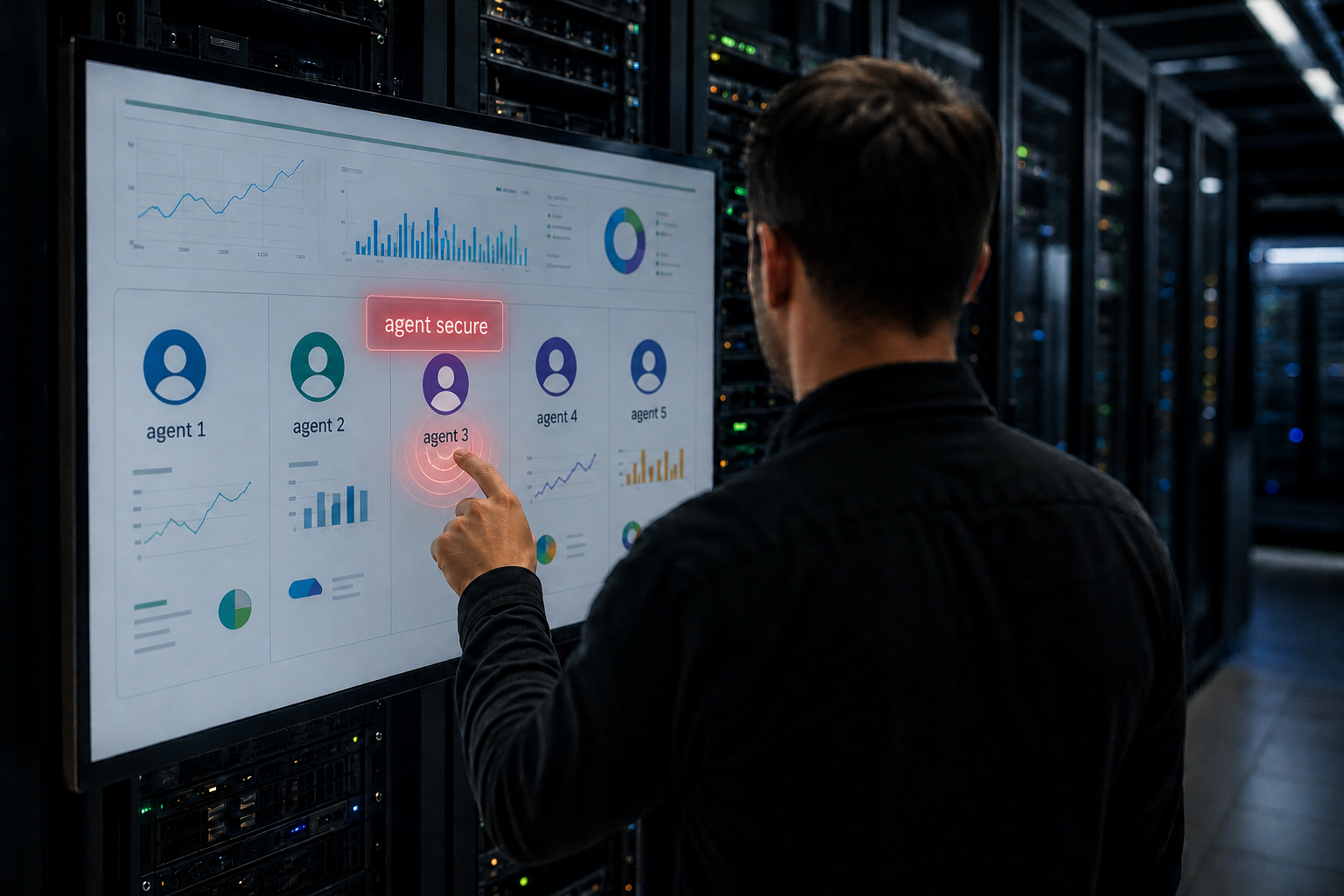
A governed AI control plane is the layer that sits between AI and the systems that run your infrastructure. Every request an AI agent makes passes through it. The control plane checks who is asking, what the request will touch, whether a person needs to approve it, and then records what happened. That is what makes IT operations automation auditable, explainable, and safe enough to run in production.
Here's why it matters now. Gartner's Predicts 2026 report expects human-in-the-loop involvement in IT operations workflows to fall from 95% in 2025 to 40% by 2028. As people step back from each individual action, something else has to hold the line between an AI decision and a production change. In many enterprises, that layer doesn't exist yet. AI tools connect to systems directly, and the only record is whatever each tool happens to log.
How does a governed AI control plane work?
The easiest way to see it is to follow one request. Say an AI agent wants to decommission a server it believes is idle. In a governed control plane, that request passes four checkpoints before anything changes.
- Access: The request runs with the signed-in user's role-based access, checked on every call.
- Context: The control plane looks up what else the change will touch: the applications that depend on the server, who owns it, whether it is still in use, and where it sits in its lifecycle. That only works if the underlying data is clean and current.
- Policy and approval: The organization sets a tiered write policy. A task can be read-only, require confirmation for every write, or run under a blanket approval with a ceiling on how many records it can change. Today a person approves before every write.
- Record: The action is logged with what changed, who approved it, what it touched, and the outcome, in a tamper-evident audit trail.
Two more protections run underneath all four: prompt-injection defense, which guards against instructions hidden in tickets, logs, or documents, and optional pseudonymization for organizations that require it.
At ReadyWorks, ReadyAI is that control plane. It sits on top of the platform's unified data fabric and application context layer, and it works with the model you choose. Because governance lives in the control plane, the rules stay the same when the model changes. Your own agents can use the same foundation through a governed MCP tool surface, with the same access checks on every call.
What makes an AI action explainable and audit-ready?
In IT operations, an explainable action is one a reviewer can reconstruct after the fact. They can see the records the AI read, what it recommended, why, who approved it, and what happened next. That is a higher bar than a log line saying a script ran.
And here's the problem most teams hit first. An explanation is only as good as the data behind it. If the AI recommended retiring a server because the CMDB said it had no owner, and the CMDB was wrong, the audit trail will faithfully explain a bad decision. So audit-ready automation starts with the data foundation. The records have to be connected, cleaned, and kept current before the explanation means anything.
Auditors ask the same questions every time. We walked through them for migrations in Would Your VMware Migration Cutover Survive an Audit?, and the pattern holds for daily operations too. If your team can answer who approved a change, what else it touched, and what the outcome was, from one change history instead of rebuilding the story from spreadsheets, the automation is audit-ready.
How has our thinking on AI governance changed?
We have written about AI governance before, and our view has sharpened since. In July, we described AI governance as an extension of infrastructure observability. If you could see the estate, you could govern the AI running on it. Visibility still matters. But we learned that seeing an action is different from controlling it, and enterprises need control before the action runs.
In September, we compared the categories of governed AI agents and showed where each one enforces policy. That piece still holds. What has changed is how precisely we describe our own role. ReadyAI is one control plane, and it works at the Assisted stage today: it recommends, a person approves, and it carries out governed platform actions. We have also tightened our claims. We promise rollback where it applies, which today is automated rollback in EndpointReady. Everywhere else, we promise what we can show on record.
The longer arc goes back further. ReadyWorks has been recognized in 26 Gartner Hype Cycle reports since 2022, as a Sample Vendor across 10 distinct Hype Cycles. That recognition began with Digital Platform Conductor tools, which orchestrate work across the systems an enterprise already runs. The move to Agentic ITOps kept that foundation and added AI on top. The data foundation and the orchestration came first. The AI came after. I think that order is the reason the governance holds up.
Governance Is How Autonomy Gets Earned
Every infrastructure leader I talk to wants the same thing from AI. They want their team to spend less time on repeatable work and more time on the decisions that matter. Nobody I've met wants to hand over production on faith.
That's the real job of a governed AI control plane. It turns trust into something you can measure. Each approved action, each clean outcome, each audit that closes without surprises becomes evidence. Once that evidence builds, you widen the policy, from confirming every write to a blanket approval with limits, and eventually to semi-autonomous operations within boundaries you define. You set the pace. Autonomy becomes something your organization earns one program at a time, on the record.
I believe the enterprises that get the most from AI in IT operations will be the ones that can show their board, their auditors, and their own teams exactly what the AI did and why. Speed follows from that. That's a hybrid workforce of people and AI, and it starts with the control plane.
If you want to see where your organization would start, map your journey on our ten steps page. The module is interactive. Answer a few questions about your estate, and it lays out your first steps, your first governed actions, and who does the work. You can share the results with your leadership team, so the conversation about AI in IT operations starts from the same picture.
If you'd rather work through it with us, talk to someone who has done this.
Frequently Asked Questions
What is a governed AI control plane?
A governed AI control plane is the layer between AI and your infrastructure systems that checks access, looks up what a change will touch, applies the organization's approval policy, and records every action in a tamper-evident audit trail. It is what makes AI-driven IT operations automation auditable and explainable.
How is a governed AI control plane different from AI guardrails?
Model and gateway guardrails screen what a model receives and returns. A governed AI control plane governs the actions AI takes against the estate: what it can change, who must approve it, and what gets recorded.
Can I use my own AI agents with a governed AI control plane?
Yes, in most cases. ReadyWorks lets your own agents use the same data foundation through a governed MCP tool surface, with the signed-in user's role-based access checked on every call.
How much human approval should a control plane require?
Start with a person approving every write. Widen the policy as results hold up, moving to blanket approvals with record limits and then to semi-autonomous operations within boundaries the organization defines.